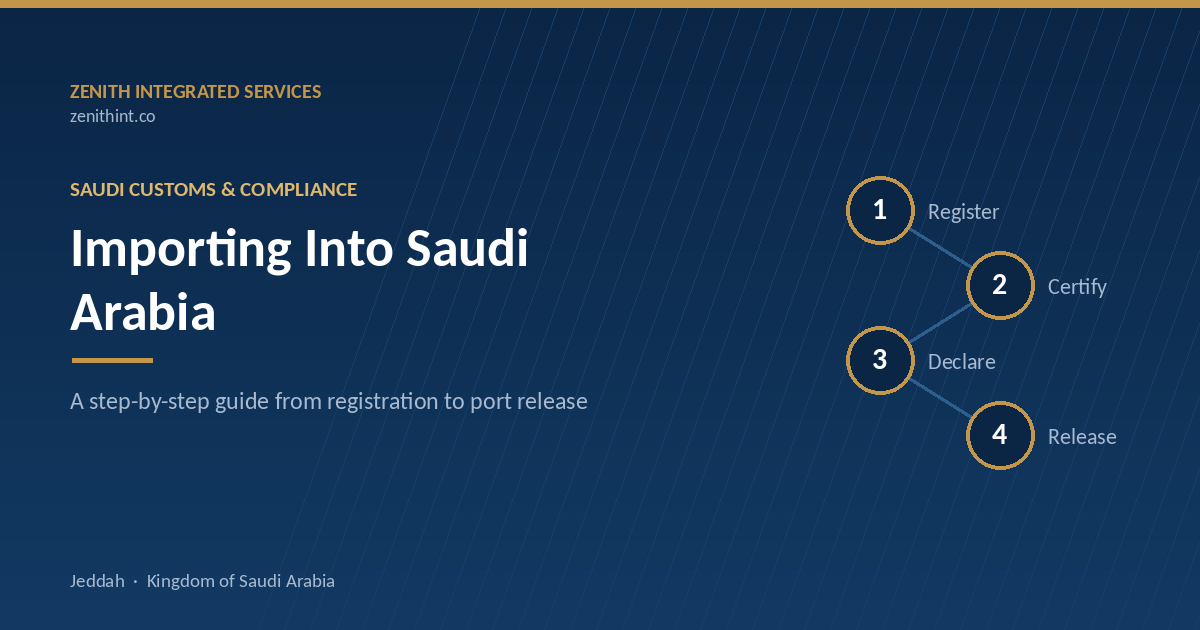
Importing into the Kingdom is not difficult once you know the sequence. It becomes difficult when steps are taken out of order — and almost every costly delay we handle is an order-of-operations problem.
Saudi Arabia is one of the most digitised trading environments in the region. The procedures are clear, the platforms work, and a well-prepared shipment clears quickly. What catches importers out is that several critical steps have to happen before the goods ever leave the origin country — and by the time a container is sitting at Jeddah, the cheap fixes are gone.
This guide walks through the full process in the order it actually happens, with the documents, the costs and the realistic timings at each stage.
Before anything else: your company setup
You cannot import commercially into Saudi Arabia as an individual or an unregistered entity. Before you place a first order, you need:
- A Commercial Registration (CR) from the Ministry of Commerce, with an activity that covers importing and trading the goods in question.
- VAT registration with ZATCA, the Zakat, Tax and Customs Authority.
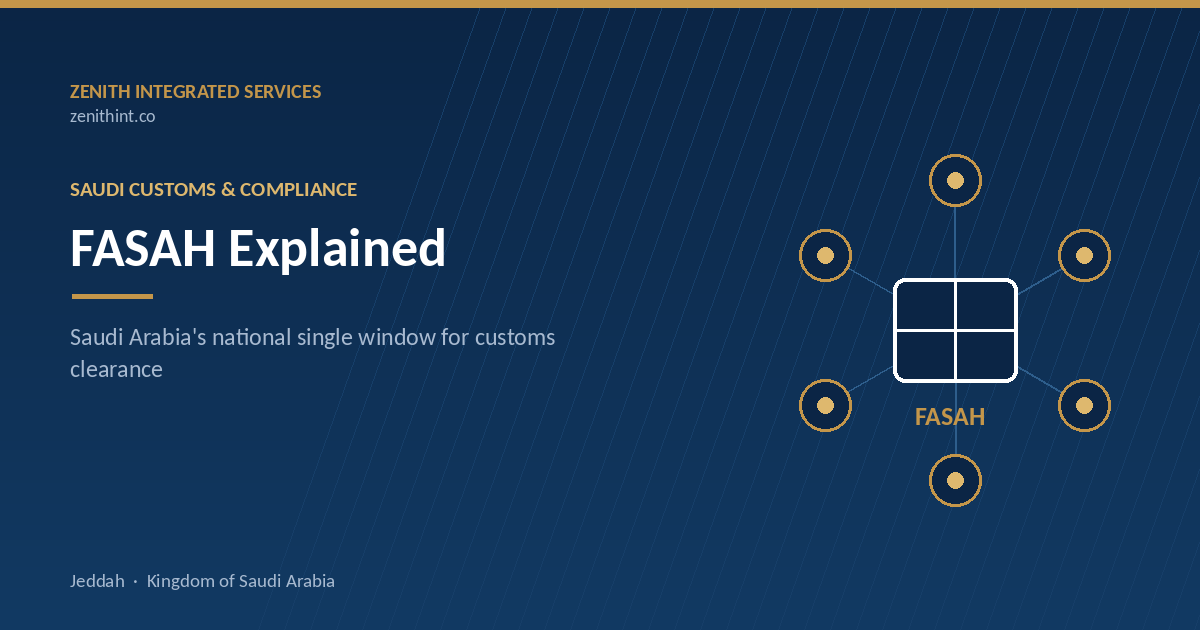
- An importer record with customs, and an account on FASAH, the national customs single window.
- An authorised customs broker, appointed through the platform for each port you intend to use.
If you are a foreign company without a Saudi entity, you will import through a registered local importer or distributor. That party becomes the importer of record, with the legal responsibilities that come with it.
Step 1 — Confirm the goods can be imported, and classify them
Two questions, both answered before you order. Is the product permitted, restricted or prohibited? And what is its HS code?
The HS code drives everything downstream: the duty rate, whether conformity certification is required, whether a special permit is needed, and how customs will value the consignment. Getting it wrong is not a paperwork problem — it changes the amount you owe and can trigger penalties. Classify from the product specification, not from a supplier's invoice description, and have it confirmed by your broker before you commit to the purchase.
Restricted categories that commonly need additional approvals include pharmaceuticals and medical devices, food products, telecoms equipment, chemicals and dangerous goods, cosmetics, and anything with a security or defence dimension.
Step 2 — Handle conformity certification
Most consumer and industrial goods require SABER conformity certification before they can clear. The product is registered on the platform, a product certificate is issued against the applicable Saudi technical regulation, and a shipment certificate is issued for each consignment.
The critical point: this work belongs at the origin, weeks before shipment. The certificate description must match your commercial invoice exactly. Discovering a certification gap after arrival is the single most expensive mistake in Saudi importing.
Step 3 — Choose your Incoterm and mode
The Incoterm decides who arranges and pays for each leg, and where risk transfers. For Saudi imports the practical consideration is control: under terms where the supplier controls the main carriage, you inherit their choice of carrier, their timing and sometimes their documentation habits — and you still carry the clearance risk.
| Common term | Who arranges main carriage | Practical note for Saudi importers |
|---|---|---|
| EXW | Buyer | Maximum control, maximum admin. Best when you have a forwarder you trust at origin. |
| FOB | Buyer, from port of loading | The most common workable balance for first-time importers. |
| CIF / CFR | Seller | Convenient, but you lose visibility over carrier choice and often pay inflated destination charges. |
| DDP | Seller, including duties | Rarely advisable into Saudi Arabia — the seller must handle Saudi tax and customs obligations they usually cannot. |
Mode follows value and urgency. High-value or time-critical cargo justifies air freight; volume cargo moves by ocean freight into Jeddah, which is the default for most importers.
Step 4 — Assemble the document set
The document pack is where most delays begin. Every document must agree with every other document.
| Document | Issued by | What customs checks |
|---|---|---|
| Commercial invoice | Supplier | Description, quantity, unit and total value, currency, Incoterm, buyer and seller details. |
| Packing list | Supplier | Package count, gross and net weights, dimensions — must reconcile to the invoice and the bill of lading. |
| Bill of lading / air waybill | Carrier | Consignee, notify party, description, container and seal numbers. |
| Certificate of origin | Chamber of commerce at origin | Origin claim, attestation where required, alignment with any preferential duty claimed. |
| Shipment certificate of conformity | SABER platform | That the consignment matches the registered and certified product. |
| Permits or approvals | Relevant Saudi authority | Required for restricted categories — food, pharma, telecoms, chemicals and similar. |
| Insurance certificate | Insurer | Where required for valuation under CIF terms. |
Step 5 — Work out the landed cost before you commit
Duty is charged on the customs value of the goods, which is normally the CIF value — cost, insurance and freight to the Saudi port. Most goods fall in the standard band, a number of categories are duty-free, and certain protected or discouraged categories carry substantially higher rates. VAT is then applied to the duty-inclusive value.
A simplified worked example, using a five per cent duty rate and the standard VAT rate:
| Line | Basis | Amount (SAR) |
|---|---|---|
| CIF value of goods | Cost + insurance + freight | 187,500 |
| Customs duty | 5% of CIF | 9,375 |
| Duty-inclusive value | CIF + duty | 196,875 |
| VAT | 15% of duty-inclusive value | 29,531 |
| Total duty and tax | 38,906 | |
| Plus | Platform fees, port and terminal handling, brokerage, inland transport | Varies |
Duty rates are set by HS code and are revised periodically, so confirm the current rate for your specific classification rather than assuming the standard band. VAT-registered businesses can generally recover import VAT through their return, but it is still cash out at the border — plan for it.
Step 6 — Declare through FASAH
Once the vessel is en route, the shipping line submits the manifest and your broker files the customs declaration with the HS codes, values, origin and supporting documents. Customs assesses the declaration, confirms classification and valuation, and calculates what is due. Duty and VAT are paid electronically, and the shipment is either released on documents or selected for inspection.
Good brokers file before arrival wherever possible. Pre-arrival declaration is the difference between a container that moves on day one and one that begins its clearance process only after it has already started accruing storage.
Step 7 — Inspection and release
Shipments may be released on documents, scanned, or physically examined. Selection is risk-based: new importers, new commodities, high-risk categories and any inconsistency in the documents all raise the likelihood of examination.
If your shipment is examined, the cost and the time are yours. Correctly described, accurately valued and properly certified cargo passes examination without incident — the problems arise where the box does not match the paperwork.
Step 8 — Delivery order, collection and the demurrage clock
Customs release is not the same as being able to collect. You also need the delivery order from the shipping line, which is issued once line charges are settled, and port charges must be cleared. Only then can the container leave the terminal.
Two clocks are running from arrival. Demurrage is charged by the shipping line for the container remaining inside the terminal beyond free time. Detention is charged once the container leaves the terminal but is not returned empty in time. Both are avoidable with pre-arrival preparation and a transport plan agreed before the vessel berths. Where cargo genuinely needs to be held, bonded and free-zone warehousing is a cheaper place to hold it than a terminal.
Realistic timings
| Stage | Typical duration | What extends it |
|---|---|---|
| Company and platform setup | One-off, allow 2–6 weeks | Incomplete CR activities, VAT registration delays |
| SABER certification (first time) | Days to several weeks | Missing or non-accredited test reports |
| Ocean transit to Jeddah | 12–35 days depending on origin | Transhipment, routing, congestion |
| Customs clearance at Jeddah | 1–5 working days | Document mismatch, inspection, valuation query |
| Delivery order and gate out | 1–2 days after release | Unsettled line or port charges, no transport booked |
The mistakes that cost the most
- Starting conformity certification after the goods have shipped.
- Letting the supplier write a vague invoice description that does not match the certificate or the HS code.
- Choosing an HS code for a convenient duty rate rather than an accurate one.
- Budgeting for freight but not for duty, VAT and destination charges.
- Agreeing CIF or DDP terms without understanding what you have given away.
- Appointing a broker after arrival instead of before departure.
- No transport plan for the day of release, so the container sits.
- Treating a first shipment as a test without the compliance groundwork — first shipments are inspected more often, not less.
How Zenith handles the whole chain
We are a Jeddah-based freight forwarder with licensed customs brokerage capability, which means one accountable team from origin booking through to delivered cargo. Our clients typically use us for the full chain: origin pickup, ocean freight into Jeddah or air freight for urgent cargo, customs clearance in Saudi Arabia, and onward delivery.
The work that makes the difference happens before anything moves — confirming classification, checking the conformity position, verifying the document pack, and giving you a landed cost you can actually plan against.
Frequently Asked Questions
What documents do I need to import into Saudi Arabia?
At minimum: a commercial invoice, packing list, bill of lading or air waybill, and certificate of origin. Most goods also require a shipment certificate of conformity from the SABER platform, and restricted categories need additional permits from the relevant authority.
How much is import duty in Saudi Arabia?
Duty is set by HS code. A large share of goods falls in the standard band, some categories are duty-free, and certain protected or discouraged categories carry significantly higher rates. Duty is calculated on the CIF value, and VAT is then applied to the duty-inclusive value. Confirm the current rate for your specific classification before ordering.
Can I import into Saudi Arabia without a local company?
Not as the importer of record. Commercial imports require a Saudi Commercial Registration, VAT registration and a customs importer record. Foreign suppliers typically sell to a registered Saudi importer or distributor who acts as importer of record.
How long does customs clearance take at Jeddah?
With a complete and consistent document set and no inspection, commonly one to five working days from arrival. Physical examination, valuation queries or missing certificates extend that significantly.
Do I need a customs broker?
For commercial cargo, in practice yes. Classification, valuation, conformity and inspection handling are specialist work, and the broker must be authorised in the customs platform for the specific port you are using.
What is the difference between FASAH and SABER?
SABER is the conformity platform where products are registered and certificates of conformity are issued before shipment. FASAH is the customs single window where the shipment is declared, assessed and released on arrival. The two are integrated, so a conformity problem stops a customs declaration.
Written by the Zenith Customs Desk — our licensed customs brokerage team in Jeddah, clearing cargo daily at Jeddah Islamic Port, King Abdullah Port and King Abdulaziz Port, Dammam.
- Import Guide
- Customs Clearance
- FASAH
- SABER
- ZATCA
- Saudi Arabia
- Landed Cost