Every commercial shipment entering Saudi Arabia passes through FASAH. Understanding how it works is the difference between a container that clears in two days and one that sits accruing demurrage for two weeks.
If you import into the Kingdom, you have almost certainly heard the name FASAH — usually from a broker explaining why a shipment has not moved. It is worth understanding properly, because most clearance delays in Saudi Arabia are not caused by the platform itself. They are caused by information that was wrong, missing or inconsistent before the declaration was ever submitted.
This guide explains what FASAH is, who needs access to it, what happens to your shipment inside it, and the handful of mistakes that account for most of the delays we see at Jeddah Islamic Port.
What FASAH actually is
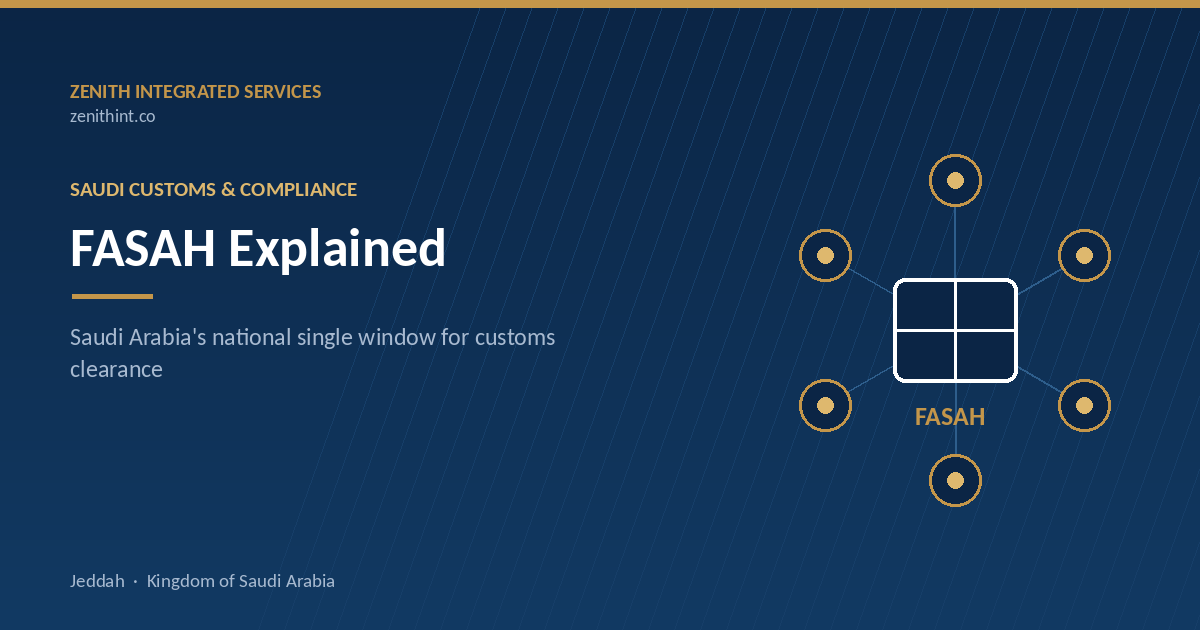
FASAH (fasah.sa) is Saudi Arabia's National Single Window for foreign trade. Instead of dealing separately with customs, the port, the shipping line and half a dozen regulatory bodies, every party submits and receives information through one platform.
It is operated by Saudi eTabadul Company (Tabadul) under the supervision of the Zakat, Tax and Customs Authority (ZATCA), which is the authority responsible for customs in the Kingdom. It connects importers, exporters, customs brokers, freight forwarders, shipping agents and port operators with customs and the government entities that issue permits and approvals.
In practice that means the manifest, the customs declaration, the duty and tax payment, the inspection instruction, the release and the delivery order all move through a single system with a single reference for your shipment.
Who needs a FASAH account
- Importers — any company bringing commercial goods into Saudi Arabia. You cannot clear cargo without your company being registered.
- Exporters — companies shipping goods out of the Kingdom.
- Customs brokers — the licensed party that files the declaration on your behalf.
- Freight forwarders and shipping agents — for manifests, delivery orders and cargo release.
Registration requires your Commercial Registration (CR) number, your VAT registration certificate, and the national ID of the authorised person on the account. The details must match your records at the Ministry of Commerce and ZATCA exactly — a mismatched company name or an expired CR is a common reason registration stalls.
Once registered, you can authorise a customs broker to act for you at a specific port. This authorisation is given inside FASAH and is port-specific, which surprises importers who assume one authorisation covers the whole Kingdom.
What happens to your shipment inside FASAH
The sequence below is the normal path for a sea freight import arriving at Jeddah Islamic Port. Air and land follow the same logic with different timings.
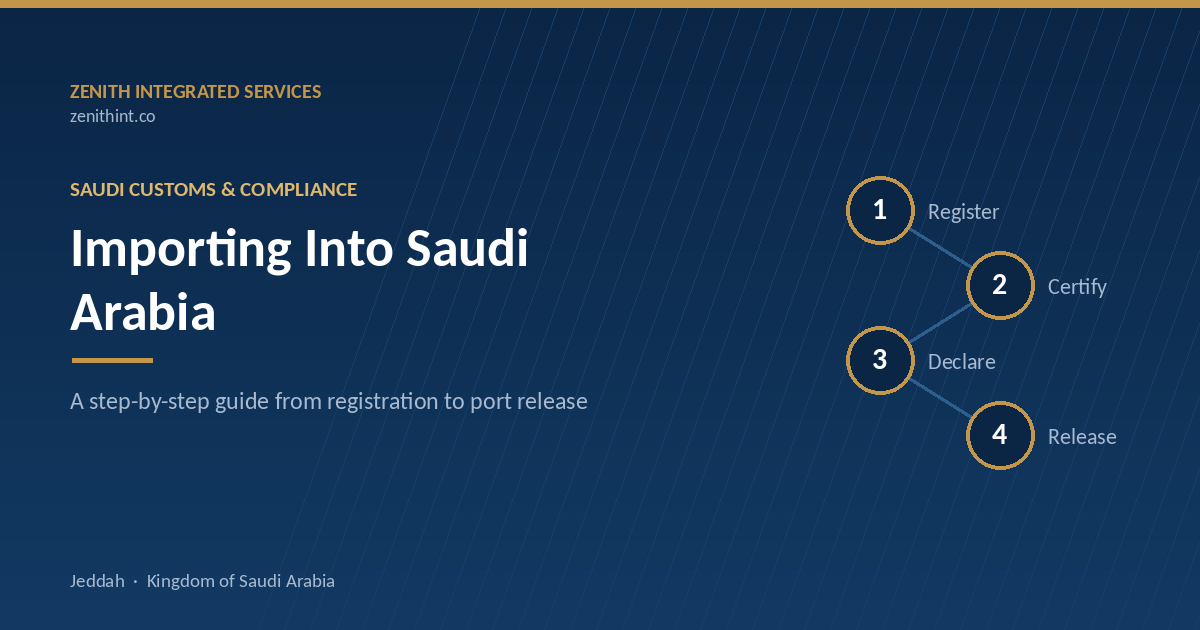
| Stage | What happens | Who does it |
|---|---|---|
| 1. Manifest | The shipping line or its agent submits the cargo manifest against the bill of lading before arrival. | Shipping agent |
| 2. Declaration | The customs declaration is filed with HS codes, values, origin and the full document set attached. | Licensed customs broker |
| 3. Assessment | Customs assesses the declaration, confirms classification and valuation, and calculates duty and VAT. | ZATCA |
| 4. Payment | Platform service fees and then customs duty and VAT are paid electronically through SADAD. | Importer or broker |
| 5. Inspection | The shipment is either released on documents or selected for scanning or physical examination. | ZATCA / port |
| 6. Release | Customs issues the release once assessment, payment and any inspection are complete. | ZATCA |
| 7. Delivery order | The delivery order is issued through the platform once line and port charges are settled. | Shipping agent / port |
| 8. Gate out | The container is collected and moves to the consignee or to a bonded facility. | Transport provider |
Payments run through SADAD. Platform service fees and customs duties and taxes are paid against separate biller codes, so make sure your finance team knows both — a payment made against the wrong code is not lost, but it does not release your cargo either. Confirm the current biller codes with your broker, as fee structures are periodically updated.
How FASAH and SABER work together
These two platforms are constantly confused, so it is worth being precise. SABER is the conformity platform run by the Saudi Standards, Metrology and Quality Organization (SASO): it is where products are registered and where certificates of conformity are issued. FASAH is the customs platform: it is where the shipment is declared and released.
They have been integrated since 2020, which means your customs declaration in FASAH is checked against the conformity certificate in SABER automatically. If the Shipment Certificate of Conformity is missing, expired, or issued against a different product description or quantity than the one on your invoice, the declaration stops. No amount of chasing at the port will move it until the certificate is corrected at source.
Rule of thumb: SABER is finished before the goods leave the origin country. FASAH begins when they arrive. Importers who reverse that order pay demurrage.
Five mistakes that cause most FASAH delays
- Document mismatch. The commercial invoice, packing list and bill of lading disagree on quantity, weight, description or consignee. Customs will query it, and every query costs days.
- Wrong or lazy HS classification. A code chosen for convenience rather than accuracy triggers reclassification, a revised duty assessment, and sometimes a penalty.
- Missing SABER certificate. Discovered only after arrival, when the certificate should have been obtained before shipment.
- Certificate of origin not properly issued or attested. Requirements vary by origin country and by the preferential treatment being claimed.
- Expired or mismatched company records. An expired CR, a changed company name, or an authorisation given at the wrong port will block a declaration that is otherwise perfect.
None of these are platform problems. They are preparation problems, and all five are avoidable with a document check before the vessel sails.
How long clearance actually takes
With a complete, consistent document set and no inspection, clearance at Jeddah is commonly completed within one to five working days of arrival. Add time if the shipment is selected for physical examination, if the goods are regulated, or if a valuation query is raised. Shipments with document problems routinely take two to three weeks — which is why the pre-shipment check matters more than anything that happens at the port.
Where Zenith fits
We hold licensed customs brokerage capability and file declarations daily at Jeddah. Practically, our clients use us in one of two ways: we handle the full move including ocean freight into Jeddah and clearance as a single accountable service, or we act as customs broker only on cargo another party has shipped.
Either way, the value is in the pre-arrival work — checking the document set, confirming classification, and making sure the conformity certificate exists before the shipment moves. That is the part that keeps containers off the demurrage clock. For the wider process, see our Saudi Arabia Customs Clearance Guide 2026.
Frequently Asked Questions
What is FASAH?
FASAH is Saudi Arabia's National Single Window for foreign trade. It is the electronic platform through which customs declarations, manifests, duty payments, inspections, releases and delivery orders are processed. It is operated by Tabadul under the supervision of ZATCA.
Is FASAH mandatory for importing into Saudi Arabia?
Yes. Commercial imports and exports are declared electronically through the platform. An importer cannot clear commercial cargo without being registered, and a broker cannot file on your behalf without your authorisation in the system.
How do I register on FASAH?
Register at fasah.sa, select your user type (importer, exporter, broker, shipping agent or forwarder), and provide your Commercial Registration number, VAT certificate and the national ID of the authorised person. The details must match your official records exactly.
What is the difference between FASAH and SABER?
SABER is the SASO conformity platform where products are registered and certificates of conformity are issued before shipment. FASAH is the customs platform where the shipment is declared and released on arrival. The two are integrated, so a missing SABER certificate will stop a FASAH declaration.
How are customs duties and VAT paid?
Electronically through SADAD, against the relevant biller codes for platform fees and for customs duties and taxes. Your broker will confirm the current codes and the exact amounts due before payment.
Do I need a customs broker if I have a FASAH account?
Not legally in every case, but practically yes for commercial cargo. Classification, valuation, conformity and inspection handling are specialist work, and errors are expensive. Most importers authorise a licensed broker at each port they use.
Written by the Zenith Customs Desk — our licensed customs brokerage team in Jeddah, clearing cargo daily at Jeddah Islamic Port, King Abdullah Port and King Abdulaziz Port, Dammam.
- FASAH
- Customs Clearance
- ZATCA
- Saudi Arabia
- Jeddah
- Import Compliance