Jeddah Islamic Port handles a large share of everything the Kingdom imports. A clean shipment moves through it in a matter of days. A shipment with a paperwork problem can sit for weeks — and the cost is rarely the customs duty.
If you import into western Saudi Arabia, your cargo almost certainly arrives at Jeddah Islamic Port. It is the Kingdom's principal Red Sea gateway, sitting on one of the busiest shipping corridors in the world, and it is where our customs desk works every day.
This article covers what actually happens between a vessel berthing and a container leaving the gate: who does what, what the documents need to say, how long each stage realistically takes, and the six problems that account for most of the delays we are asked to fix.
Who does what
Clearance involves more parties than most importers expect, and a delay at any one of them stops the whole chain.
| Party | Responsibility |
|---|---|
| Importer | Holds the commercial registration and customs record, owns the commercial documents, pays duty, VAT and charges. |
| Customs broker | Files the declaration, manages classification and valuation, handles queries and inspection. |
| Shipping line / agent | Submits the manifest, issues the delivery order once line charges are settled. |
| ZATCA | Assesses the declaration, determines duty and VAT, decides on inspection, issues the release. |
| Port and terminal | Handles discharge, storage, examination facilities and gate-out. |
| Transport provider | Collects the container and delivers to the consignee or a bonded facility. |
The document pack
The rule at Jeddah is consistency. Every document must tell the same story — same description, same quantity, same weights, same consignee, same value.
- Commercial invoice — full description, quantity, unit and total value, currency, Incoterm, buyer and seller.
- Packing list — package count, gross and net weight, dimensions, reconciling to both the invoice and the bill of lading.
- Bill of lading — consignee and notify party correct, container and seal numbers matching.
- Certificate of origin — issued and attested as required for the origin country and for any preferential claim.
- Shipment certificate of conformity — obtained through SABER conformity certification before arrival.
- Permits or approvals — for food, pharmaceuticals, medical devices, telecoms equipment, chemicals and other restricted categories.
A mismatch as small as a net weight that disagrees between the packing list and the bill of lading is enough to generate a query. Queries are not disasters, but each one costs days, and days at a terminal cost money.
What the timeline actually looks like
| Stage | Typical timing | Notes |
|---|---|---|
| Manifest submission | Before arrival | Shipping agent. Late manifests delay everything downstream. |
| Declaration filing | Pre-arrival, where possible | Filing before the vessel berths is the single biggest time saver. |
| Customs assessment | Same day to 1 working day | Longer if classification or value is queried. |
| Duty and VAT payment | Same day | Electronic. Delays here are usually internal approval delays, not system delays. |
| Inspection (if selected) | 1–4 working days | Scanning is quicker; physical examination requires de-stuffing and re-stuffing. |
| Customs release | Same day once cleared | Release is not the same as being able to collect. |
| Delivery order and gate out | 1–2 working days | Requires line and port charges settled and transport booked. |
| Clean shipment, end to end | 1–5 working days from arrival | This is achievable and should be the expectation, not the exception. |
The six most common causes of delay
1. Documents that disagree with each other
The most frequent problem by a wide margin. Quantity on the invoice does not match the packing list; the description on the bill of lading is a generic one-liner; the consignee name is a trading name rather than the registered entity. Fix: have your broker review the draft documents before the supplier finalises them, not after the vessel has sailed.
2. Missing or mismatched conformity certificate
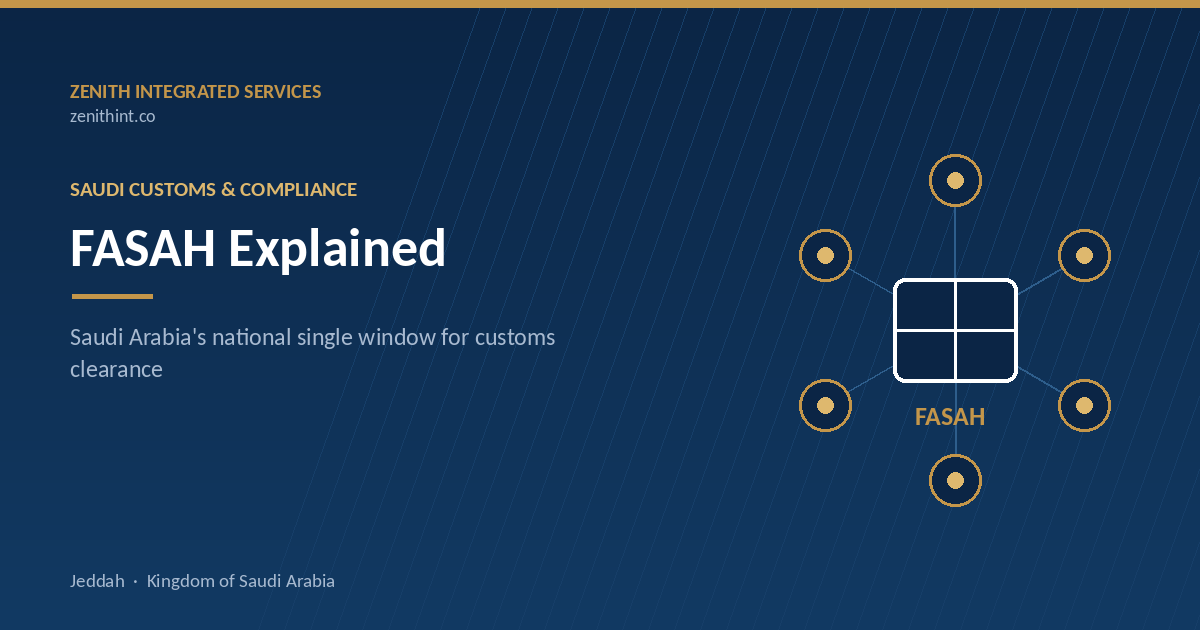
The shipment certificate is absent, has expired, or was issued against a product description or quantity that does not match the invoice. Because the conformity platform is integrated with FASAH, the national customs single window, this is caught automatically and the declaration simply stops. Fix: certificate confirmed before booking, description matched word for word to the invoice.
3. HS classification and valuation queries
A code that does not fit the goods, or a declared value customs considers understated, triggers reassessment. This can add duty, add penalties and add a week. Fix: classify from specifications with your broker before ordering, and keep the evidence supporting your declared value — contracts, payment records, freight invoices.
4. Certificate of origin problems
Not issued by the correct body, not attested where attestation is required, or inconsistent with the invoice. This matters most where preferential duty treatment is being claimed. Fix: confirm the exact origin-country requirement before shipment; it varies.
5. Delivery order and charges not settled
Cargo is customs-cleared and still cannot move because line charges are outstanding or port dues are unpaid. Importers are often unaware the shipment is waiting on a payment rather than on customs. Fix: get the full destination charge schedule at booking, particularly on CIF shipments where destination charges are frequently higher than expected.
6. No transport plan for release day
Release comes through, and there is no truck. Meanwhile demurrage accrues. Fix: book ground and intermodal transport against the expected release date, not after release is confirmed.
Demurrage and detention — know which clock is running
These two are constantly mixed up and they are charged by different parties for different things.
| Demurrage | Detention | |
|---|---|---|
| What it covers | The container remaining inside the terminal beyond the agreed free time. | The container outside the terminal, not returned empty within the agreed free time. |
| Charged by | Shipping line (plus terminal storage charged by the port). | Shipping line. |
| Clock starts | On discharge, after free days expire. | On gate-out, after free days expire. |
| How to avoid it | Pre-arrival declaration, complete documents, charges settled early. | Unload promptly and plan the empty return. |
Free time varies by carrier and by contract. Negotiate it at booking, especially on routes where you know clearance may be complex. If cargo genuinely needs to be held, bonded and free-zone warehousing is almost always cheaper than leaving it on the terminal.
Pre-arrival checklist
Run this before the vessel berths and most Jeddah clearance problems disappear.
- HS code confirmed and agreed with your broker.
- Conformity certificate issued, valid, and matching the invoice description and quantity.
- Invoice, packing list and bill of lading cross-checked for consistency.
- Certificate of origin issued and attested as required.
- Any category-specific permits obtained.
- Broker authorised in the customs platform for Jeddah specifically.
- Duty and VAT budgeted, with internal payment approval already in place.
- Destination charges from the line confirmed in writing.
- Transport booked against the expected release date.
Why local presence matters here
Clearance is partly procedural and partly relational. Knowing which examination bay a shipment has been routed to, who to speak to about a valuation query, and how a particular terminal handles a de-stuff request is not something that can be managed remotely from another country.
Zenith is headquartered in Jeddah with licensed customs brokerage capability. We handle customs clearance in Saudi Arabia as a standalone service for cargo other parties have shipped, and as part of a full door-to-door move. If you are new to the market, start with our guide on how to import goods into Saudi Arabia, which covers the whole process from company registration onward.
Frequently Asked Questions
How long does customs clearance take at Jeddah Islamic Port?
With a complete, consistent document set and no inspection, commonly one to five working days from arrival. Physical examination, a valuation query or a missing conformity certificate can extend this to several weeks.
What documents are required for customs clearance in Jeddah?
Commercial invoice, packing list, bill of lading, and certificate of origin at minimum. Most goods also require a shipment certificate of conformity, and restricted categories require additional permits from the relevant Saudi authority.
Do I need a customs broker in Jeddah?
For commercial cargo, in practice yes. The broker must be authorised in the customs platform for Jeddah specifically — an authorisation given at another port does not carry across.
What is the difference between demurrage and detention?
Demurrage applies while the container remains inside the terminal beyond free time. Detention applies once the container has left the terminal but has not been returned empty in time. Both are charged by the shipping line, and terminal storage is charged separately by the port.
Can I clear cargo at Jeddah before the vessel arrives?
The declaration can generally be filed before arrival once the manifest is submitted, which is the most effective way to compress the timeline. Release still follows arrival, assessment, payment and any inspection.
What happens if my shipment is selected for physical inspection?
The container is moved to an examination area and opened for verification against the declaration. Costs and handling time are for the importer's account. Accurately described, correctly valued and properly certified cargo passes without incident.
Written by the Zenith Customs Desk — our licensed customs brokerage team in Jeddah, clearing cargo daily at Jeddah Islamic Port, King Abdullah Port and King Abdulaziz Port, Dammam.
- Customs Clearance
- Jeddah
- Jeddah Islamic Port
- Demurrage
- FASAH
- Saudi Arabia